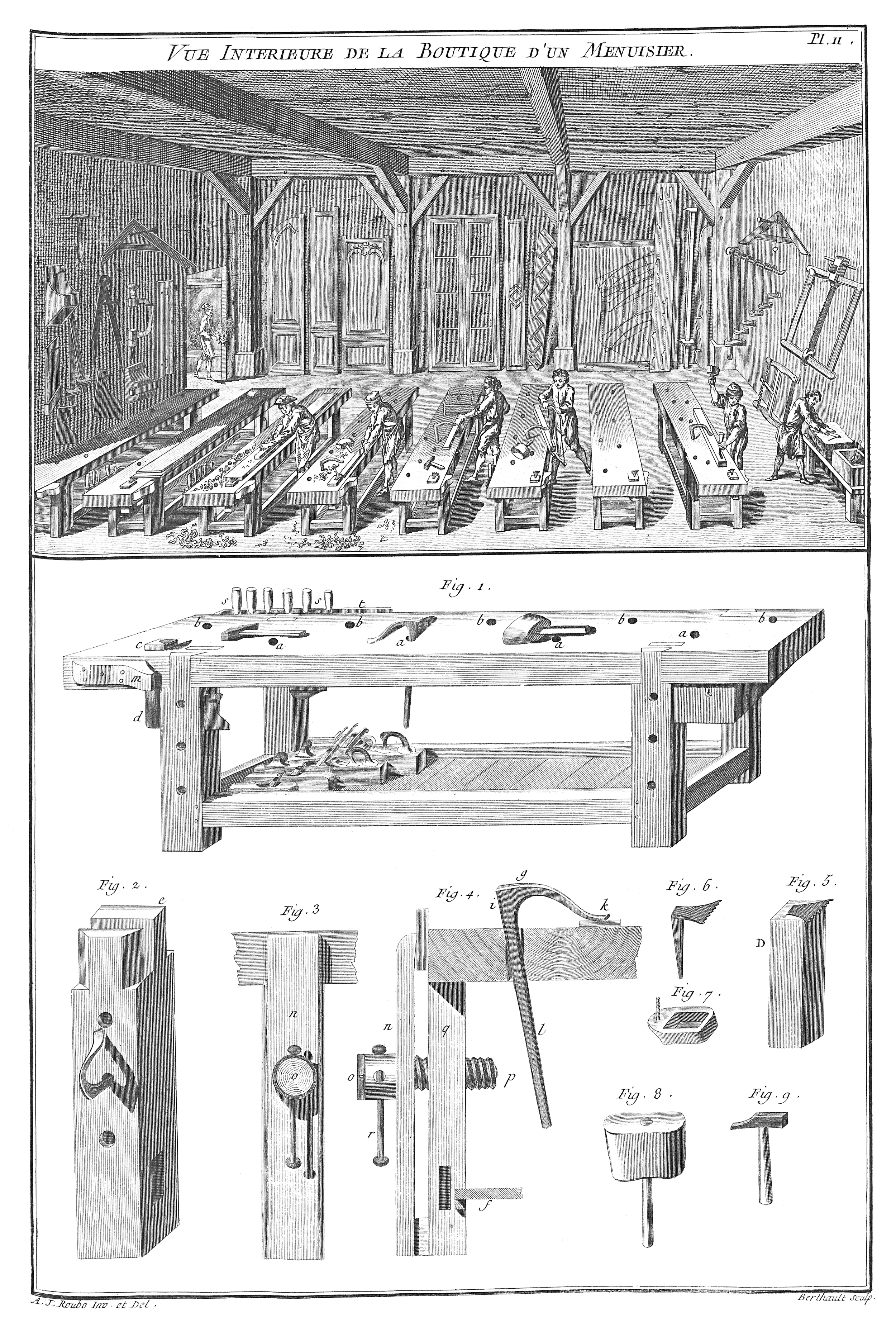
I first discovered Roubo’s workbench through Christopher Schwarz’s book The Anarchist’s Workbench, published by Lost Art Press. Amazingly, Mr. Schwarz has made the book available for free. I’ll link to it here. I own copies of each book in the Anarchist series and highly recommended them.
André Jacob Roubo (1739–1791) was a French carpenter, cabinetmaker, and author whose legacy rests largely on his monumental treatise L’Art du Menuisier (“The Art of the Carpenter”). Born in Paris to a family of woodworkers, he apprenticed under his father at age eleven and went on to educate himself in mathematics, design, and architectural principles, eventually studying under Jean-François Blondel. Between 1769 and 1775, Roubo published his four-volume masterwork under the patronage of the Académie des Sciences, documenting nearly every aspect of 18th-century woodworking. The books span building joinery, interior woodwork, furniture and cabinetmaking, and garden structures. These works include hundreds of engraved plates that he drew and designed himself. Roubo also authored a treatise on theatre construction and stage machinery. Today he is especially revered for his straightforward, massively built workbench design, which modern woodworkers continue to build and rely on. A street in Paris now bears his name, honoring his enduring influence on the craft.
The workbench featured on my homepage is taken from one of Roubo’s most famous illustrations, Plate 11. If you’re interested in the history of woodworking, I highly recommend visiting his Wikipedia page to learn more. I’ll also refer you to Christopher Schwarz’s blog post on this matter linked here.